[space + justice]

The adventures of a UNCC architecture studio exploring the contemporary American courthouse.

Category: Precedent

Precedent Analysis

by mcanadayuncc

Precedent Study:

… “but above all, the courthouse: the center, the focus, the hub; sitting looming in the center of the county’s circumference like a single cloud in its ring of horizon, laying out its vast shadow to the uttermost rim of horizon; musing, brooding, symbolic and ponderable, tall as cloud, solid as rock, dominating all: protector of the weak, judiciate and curb of the passions and lusts, repository and guardian of the aspirations and hopes”…

-William Faulkner, Requiem for a Nun

The courthouse in the square is uniquely American. To open gathering spaces in the center of towns can be found both in classical antiquity, as the Roman ‘agora,’ and throughout Europe dating back to medieval times, as Italian piazzas and Spanish plazas. In “The Central Courthouse Square in the American County Seat traces its roots to early eighteenth century settlements along the east coast…” Over 1,000 courthouse squares were built in counties through- out the United States.

Image

John Joseph Moakley United States Court- house in Boston, Massachusetts is located on Fan Pier.

-2 courtrooms for the Court of Appeals -25 courtrooms for the District Court -40 judges’ chambers

-Circuit law library

-Office of a United States Congressman -Offices for the United States Attorney -Extensive support facilities for the United States Marshals service and Pre-Trial and Probation services

-Day-care facility

-108′ high sky lit Rotunda, Great Hall shaped by a 372′ long sloped glass conoid

-Outdoor arcade

-2.3-acre landscaped park

Waterfront amenities

-Cafe

-Information center and excursion boat ticket office in an arcaded waterfront loggia -spaces for exhibitions, lectures, meetings, and dining in the Great Hall of the court- house

Materials

-Glass

-Water-struck brick with granite trim


Image

The United States Courthouse in San Diego, designed by Richard Meier, consists of a sustainable modern tower and plaza for public use. This new architecture is integrated with the surrounding existing federal buildings and engages the urban fabric of San Diego.

The circulation of the main tower is located on the East facade to allow views overlooking the public plaza, city, and South Bay.

This slender tower is surrounded by a glass facade and oriented such that natural light enters the building from the East and West. The courtroom as well as most of the building is naturally lit with diffused sunlight.

The lobby is an elliptical volume with a glass roof allowing for sufficient day lighting and many levels of circulation to provide a playful transitioning space for visitors and employees
Image

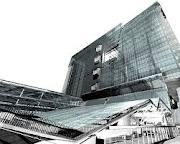
San Francisco Federal Building- Morphosis uses sustainable design to maximize energy efficiency to create a high quality workspace that redefines bureaucratic culture.

“The project has developed around three primary objectives: the establishment of a benchmark for sustainable building design through the efficient use of natural energy sources; the redefinition of the culture of the work- place through office environments that boost workers’ health, productivity, and creativity; and the creation of an urban landmark that engages with the community.”

A tall, slender tower that provides an energy efficient work/public environment through its shape, orientation, and integration of structural, mechanical, and electrical systems.

Public

-Free standing cafe

-Conference center

-Fitness center

-Daycare center

Circulation

-Places for employees to gather

-”Chance encounters”

-“Democratic layout”

-Work areas at the buildings perimeter

-Private offices and conference spaces are the core

-Skip stop elevators Crossectional interaction

-Sky gardens, tea salons

-Large open stair

-Flexible floor plans

-Elimination of corner offices

Energy Efficiency

-”Living skin”

-Integration of structural, mechanical, and electrical systems -natural ventilation – 70% of workspaces (6th floor and up) -natural light – 90% of workspaces

Folded perforated metal building skin shades the window walls of the North facade.

Computer operated panels open and close with the change of seasons/climate to provide comfortable, naturally ventilated temperature adjustments.

by pdgaither

This slideshow requires JavaScript.

During the site visit I was looking for areas of site placement that would connect the law school to the park and vice versa. The continuous red string denotes the path taken while on site and the volumes of red string denote areas of the site that I thought could serve as a possible placement of program. There needs to be a connective tissue within the site that brings the different programs together. Looking at the site I hope to bring these programs together and develop the overall site and not just the immediate site context.

Activating Public Space

by cchlebda

According to the article “Modern Courthouses and the New Green,” the idea of a courthouse in the square is specific to American society (Dibble 30).  A courthouse square can slow down the courthouse entry approach for visitors, helping them to orient themselves on the site with or without an over-sized, imposing facade like those used in many modern (i.e. large, glazed atria) and colonial courthouses (i.e. portico with pediment and columns). Also, a square can create a welcoming atmosphere, visually inviting the public to enter the courthouse. The law exists for the people, so the courthouse and the space surrounding it should be designed to invite the public to participate in the law.

The idea of bringing people to the courthouse through urban design, i.e. through the creation of usable, public space directly adjacent to the courthouse, was of particular interest to me as I researched historical and modern precedents. I looked for examples that would demonstrate a variety of ways to activate the courthouse square.

One of the modern courthouses I researched was the Alfred A. Arraj Courthouse in Denver Colorado. The architects of this courthouse, HOK and Anderson Mason Dale Architects, created a urban space at the front of an entry pavilion that encourages passersby and users of the courthouse to enter the square and stay. The square features fountains, planters, and benches, all of which contribute to a pleasant and inviting atmosphere, while also providing security against vehicular threats to the courthouse.

Another way to incorporate alternate public uses into the space surrounding the courthouse is deomonstrated in the Colonial-era Boston Town House. The Town House was originally located at the center of Boston in the middle of a public square. It was a two-story building with courtrooms on the second floor and a market on the ground floor. By incorporating this alternate, mercantile use into the courthouse, the designer(s) encouraged an always active atmosphere around the courthouse.

Works Cited

Dibble, Tim and Fiona Cousins. “Modern Courthouses and the New Green.” The Court Manager 22.4 (2009): 30-41. National Association for Court Management. Web. 3 Sept. 2012. <www.nacmnet.org>.

COURTHOUSE FACADES: Possibilities other than “Official Style”?

by workbymariahroth

When one speaks of courthouses automatically the image of a classical façade of columns and pediment come to mind.  With this visual also comes the thought of not a very public inviting space.  However, in this era of design is it possible to reinterpret a typical courthouse façade and make it more inviting to the public?

Historically, the exterior design of courthouses is composed of a high plinth, classical columns, raised pediments and is typically colored white.  The white color is often just a product of the material being used, often times granite or marble.  These materials are often used to signify the importance and high quality of the building.  These materials and design are often why the public doesn’t feel as invited into this space that should be theirs.  Interestingly though, not all historic courthouses take on this “official style”.  Dating as far back at early 1700s in the United States courthouses strayed from this popular notion.  One particular example that looks nothing like a courthouse and more of a plantation home is the Queen Anne’s County Court House, located in Centerville, Maryland.  Courthouses come in many different varieties of design, however historically it has always been the classical “official style” that has been ingrained in everyone’s mind.  Therefore in this modern era is it possible to redesign the notion of what a courthouse looks like to the public?

Google “modern American courthouses”, the result: some modern but still that classical “official style” everyone knows of.  Though, take some time to actually research the subject and you will find that there are quite a bit of modern courthouses, they just aren’t well documented (yet) or known.  Such examples of modern courthouses are: Wheeling Federal Building and US District Courthouse (Wheeling, West Virginia!), Sandra Day O’Conner US Courthouse (Phoenix, Arizona), Lloyd D. George Federal Courthouse (Las Vegas, Nevada), Federal Building and US Courthouse (Islip, New York), Wayne Lyman Morse US Courthouse (Eugene, Oregon), US Federal Courthouse (Brooklyn, New York), US District Courthouse (Orlando, Florida).  These are just a few of the examples of modern courthouse within the US, look outside of America and one can find many more.

So even though we are designing contemporary/modern courthouses can/will this change the notion of the courthouse to the public?

Advanced Criminal Law and You

by caroothers

The Courthouse is really the expression of the justice system in a democracy.  It has to be very open, and yet has to be secure … The idea of openness representing freedom in democracy [is] really an important part of the concept.

–  Gyo Obata

The modern day courthouse is the result of a steady evolution in civic architecture that has spanned the timeline of civilized societies. Throughout this evolution there are common similarities between the civic architectures of each age.  The courthouses of the Ancient Greeks, Early Americans, and the Modern Society have developed through style, program, and from, however, the common typology of civic architecture today can be traced back to the beginnings of society.

The courthouse was developed with the Greek Democracy.  The government representative of the people (the Boule) met in the Bouletarian to preform the functions of a government and bring people to trial.  The structure was designed as a piece of the greater Agora.  The original government complex developed out of the necessity to bring the government of the people, to the people.

The Bouletarian was a clever mix of forms, of a solid foundation of representatives and an open connection to those people that are represented.  The openness of the courtyard within the building walls allowed the democratic process to always be open to the society.  The judgement of an individual is done by their peers under the broad scope of society.  The elements of architecture that composed the Bouletarian were so basic and fundamental, that they were adopted by the American Government to represent the foundation of a stable, strong government.  The use of the basic elements of structure (column, beam, pediment) symbolize the theory of the American Democracy today.  It is a simple system that is just, strong, and fundamental for an evolving society.

The Early American Courthouses developed as a central axis of the American Landscape.  Each town developed a cultural hub that surrounded the courthouse.  It was here that the largest metropolises were formed, and the smallest towns were maintained.  The courthouse was central to the development of the United States.  The early courthouses were placed in the center of developments, separated from other buildings, and typically taking up their own city block.  This placement allowed for the access of public lands by the people, which developed the initial commercial and residential zones which surround the downtown.  It is this courthouse architype that is so engrained in every American’s mind.  The installation of the one room courthouse, much like the Greek Bouletarian, held fate of an individual as decided by a jury of their peers.  The towns came together in these courthouses to not only hold trial, but to conduct govenment business, hold meetings, and  social functions.  This one room held more of the societical benefits than any other building in the town.  It stood alone and separated within the framework of the town as a representation of the process of law, and a symbol of authority.  The solid, gabled roof structure sat high above the ground, to show that no one is above the law.  It was a presence of a greater power, visually separated, yet open to the people it served.  The symbol of the building holds all the power in the land, yet would be powerless without the people it stands above.  It is the ultimate symbol of our founding democracy.  You are the law, but you are not above it.

Within architectural standards, this structure has only recently become challenged.  The modern courthouse pushes past the idea of a courthouse as a separate part of the urban fabric.  The public use of the building has become much more on the forefront of the design process.  Bringing the disconnected public back to the courthouse, for reasons other than court proceedings.  The new wave of courthouse design has moved from the monolithic and classical forms to the use of more modern materials within more modern typologies.  Large Glass Facades, Stone Veneer, and Huge Atriums are all standards that are starting to emerge in modern day design.  These forms and ideas have greatly changed the perception of the building within the public landscape.  No longer are people looking to the government as being above socity, the modern civic courthouse is looking back to Ancient Greece and the Agora to promote the civic functions of a society together, and to draw the people in.  The modern courthouses have developed a need for openness, the feeling that the building is accessible by the public has been thrusted to the forefront of the current design principles.  This architectural move allows for the courthouse to show that it is a part of the vernacular; it is not something that should be feared and misunderstood.  The courthouse effects the people as much as, if not more, any other branch in the American Democracy.  People should want to be involved.  It has not been until recently that this programic and formal feature has been dictating the design process.

The Greeks kept their system open to the public from the inside, to remind the representatives who they represent.  However, like the Historical concept of a courthouse, the building has been architecturally closed off from the society it serves.  That recent change in design is for the better, and it will only continue to push the way the American Court System evolves in the future.

The precedent studies looked into the diagramatic formalities of each building (one from the Classical Greek design, one Historical American Reference, and one Modern Design).  The Diagrams of Site, Entrance, Solid/Void, Program, Ciruclation, and Structure highlight how the courthouse has evolved and changed with the ever changing intracacies of Democracy.  It is a simple comparison of different buildings to find out where the similarities are, and why they may have developed that way.  The final precedent is a study on a modern addition to a historical courthouse.  The connectivity of the two different forms and the play between old and new highlighted a common typology between two drastically different forms.  This concept helped the building to keep its roots yet move to the future in a way that differs from our programatic requirements, but still poses an interesting solution.

It is this evolution of design in which I have become interested.  This same programatic structure has spanned over two thousand years, and the forms have changed drastically, however that is only of late.  The most interested phenomenon about this evolution is that the design of the courthouse has been relatively unchanged for most of its existence.  It is the recent changes that have had the most effect on the fundamental form of the building.  I am looking to discover that link between the past and the future.  How can the courthouse move forward in design with a modern form, yet hark back simple roots of classical democracy?

This slideshow requires JavaScript.

Design a site like this with WordPress.com
Get started